
The sites to be studied in SEMACRET cover a diversity of geological settings and ages including several Belts across Europe.


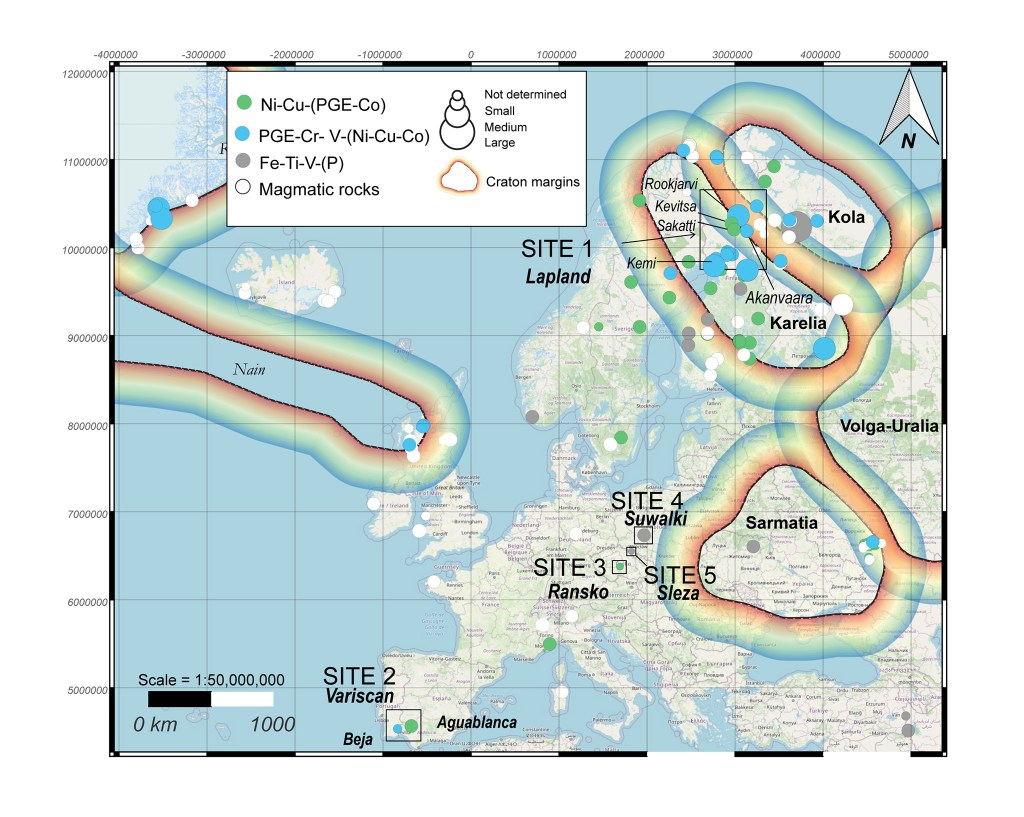
Site 1 – Lapland Belt (Finland)
This represents a geologically complex terrane and is the key region in the EU in terms of mining production and exploration potential for green transition CRMs hosted in mafic-ultramafic rocks. The Kevitsa mine is currently the largest orthomagmatic sulfide mine in the EU (250 Mt @ 0.2 wt% Ni, 0.3 wt% Cu, 0.01 wt% Co and 0.2 ppm PGE (Boliden, 2018).
The Sakatti orthomagmatic sulfide deposit was discovered 20 km south of Kevitsa in 2008 (44.4 Mt at 1.9 wt% Cu, 0.96 wt% Ni, 0.04 wt% Co and 1.13 ppm PGE), represents one of the most important mineral discoveries in the EU in recent decades (Jokela, 2017).
Lapland also contains many large layered intrusions hosting Cr-V-PGE-(Ni-Cu-Co) deposits, most notably the Kemi intrusion containing a world-class Cr deposit. In addition, there are several advanced exploration projects by junior exploration companies that have identified significant mineral resources (e.g., Koitelainen, Akanvaara, Mustavaara, and Suhanko projects). Among them, the Suhanko PGE project is at the pre-feasibility stage with construction planned to start in 2023. Because of enhanced prospectivity of the region, a large amount of data is available for our modelling, including geophysics, surficial geochemistry, and petrology.

Site 2 – Variscan Belt (Portugal)
The Ossa Morena Zone is a Variscan terrane containing numerous mafic-ultramafic intrusive bodies, including the Aguablanca Ni-Cu sulfide deposit which was mined for 2 years in the 2010s and contains a large residual mineral resource (16.5 Mt at 0.5 wt% Ni, 0.4 wt% Cu, 0.014 wt% Co, 0.5 ppm PGE, Lundin Mining, 2009; Pina, 2019). The belt also hosts a large mafic layered intrusion of similar age, i.e. the 260 km2 Beja layered sequence in southern Portugal (Jesus et al., 2014; 2016). Petrogenetic and exploration-oriented research has so far focused on the western compartment of the Beja complex, with small massive V-Ti oxide masses mineralization identified, with TiO2 up to 10 wt% and V2O5 up to 1 wt% (Jesus et al., 2003). Several Ni-Cu sulfide occurrences were identified within the western compartment (i.e to the west of the large Messejana fault). The petrogenetic features and economic potential for Fe-Ti-V oxides and Ni-Cu sulfides of the large eastern compartment of the intrusion remain largely unknown. One key reason for the relative under-exploration of the complex is that the area is intensely used by agriculture, requiring carefully designed geophysical and geochemical exploration methods.

Site 3 – Bohemian Massif (Czech Republic)
The Bohemian massif contains a number of mafic-ultramafic intrusions and dykes, possibly in a broadly analogous tectonic setting as the Variscan belt in Spain and Portugal, though most of the known intrusions are very small and could represent magma conduits rather than large layered intrusions as in the case of Reference site 2 (Jaroka et al., 2019). Several of the intrusions host high-grade Ni-Cu-(Co) mineralization (>2 wt% Ni), including the Angstberg intrusion in Germany, the Kunratice and Rožany dykes in the Czech Republic, with some of these intrusions being previously mined on a small scale. A particularly interesting target is the Ransko intrusion. There were nine Ni-Cu-Co sulfide ore deposits intersected by drilling in the 1960s (416 drill holes). However, the exploration in this belt stopped as the mineralization was considered uneconomic with the metal prices at that time, thus underexplored.

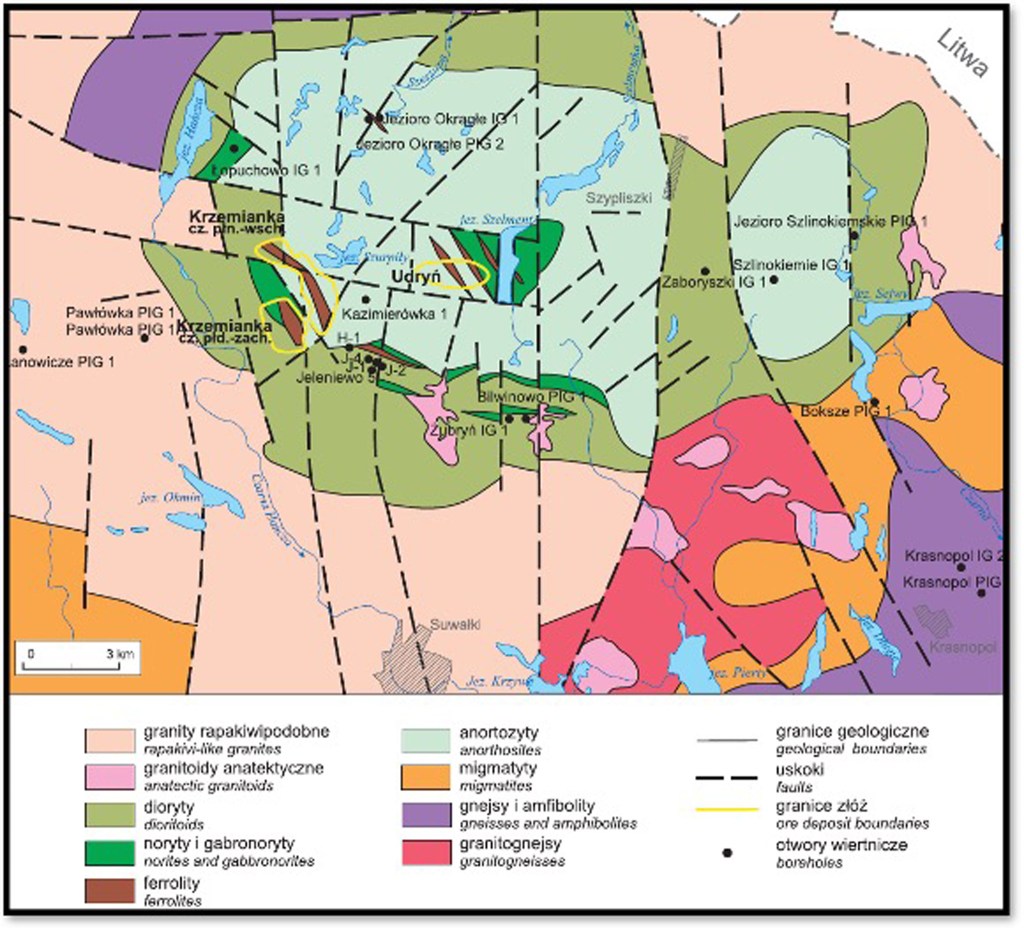
Site 4 – Suwalki massif-type anorthosite belt (NE Poland)
The Suwalki intrusion is part of a Anorthosite-Mangerite-Charnokite-Granite (Rapakivi) suite date circa 1.5 Ga. It was explored for Ti-V ores in the 2000s, encompassing geophysical surveys (magnetic, gravity, seismic) and more than 100 drill holes. The belt hosts a giant V-Ti oxide resource with more than 1500 Mt of ore at 0.3 wt% V2O5, 7 wt% TiO2 and 23 wt% Fe. The deposit is currently uneconomic due to its relatively low grade and thick cover (>500 m). However, the deposit could potentially become economic if the demand for V and Ti increases, especially considering that there is no active production of these two critical raw materials in the EU. In addition, the deposit contains Co, Ni and Sc as potential by-products. Moreover, the deposit has not been analysed for PGE, yet orthomagmatic Ti-V oxide deposits elsewhere are known to contain elevated PGE (Maier et al., 2003).
Site 5 – Sleza ophiolite (SW Poland)
The Strzegomiany-Kunów Fe-Ti-V prospect is located within the eastern edge of Ślęża ophiolite which belongs to the Central-Sudetic ophiolites (early Devonian) . In the planned research area and in the neighboring areas, small ore deposits of Fe-Ti-V, Cr, and Ni saprolite as well as traces of Cu-Ni and Pt-Pd mineralization have been documented (Mikulski, 2012). The Strzegomiany-Kunów mineralization zone, up to 6 km long and up to 250 m wide, occurs within ophitic gabbros . It has been delineated on surface and via geophysics (magnetic, gravity). Its thickness is estimated at ~80 m (Jamrozik, 1989). The Fe-Ti-V mineralization in gabbro is disseminated and dominated by ilmenite, ilmeno-magnetite and magnetite. Similar mineralizations, although with lower grades, were found in several other areas, suggesting the ophiolite is highly prospective for Fe-Ti-V mineralization.

 SEMACRET
Can I get the full references for the information sources mentioneed in the reference site descriptions?
LikeLike
Dea Pasi, I’m sorry, we missed your comment, we will post them in the beginning of May the latest. Thank you for your interest!
LikeLike