
Large regional campaigns developed at the initial stages of mineral exploration aim at identifying areas of interest with higher (“anomalous”) concentrations of certain metals that can indicate the presence of an orebody concealed underground. It is fundamental to narrow areas of potential interest for further investigation. Besides geological knowledge, researchers and explorers usually rely on indirect methods such as geophysics, but for that, you should see our next post. One of the core missions of SEMACRET is the development of non-invasive methods that enable detecting the presence of high concentrations of metals in the underground without disturbing the environment or populations.
One of the methods that has been thoroughly employed and developed in SEMACRET is plant geochemistry. Plants collect ions from the underground as nutrients through their root system such as potassium, magnesium or calcium. In addition to nutrients, plants also take up a wide range of elements, from lithium to the actinides. Plants regulate their element uptake according to their needs, resulting in a relatively stable ratio of nutrients across all plants. This ratio is only to a minor extent influenced by the concentration of nutrients in the soil or bedrock. However, if a nutrient is scarce or if certain elements have similar properties to nutrients, the pattern of “replacement” elements in plants can reflect the characteristics of the soil and bedrock’s mineral composition.
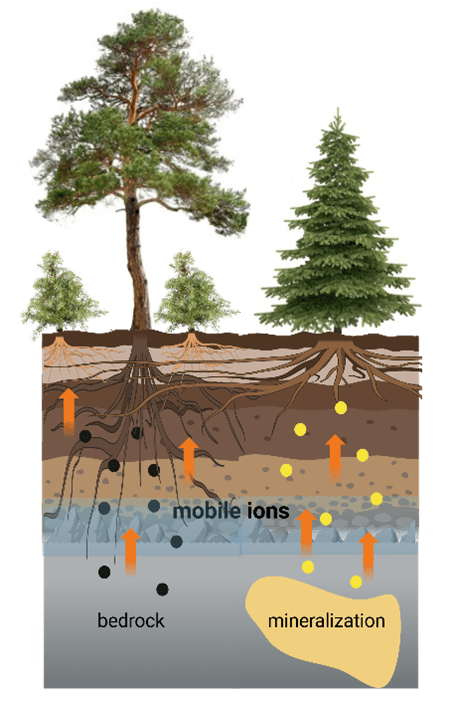
In SEMACRET we took this knowledge several steps further, and investigated if plants can reflect geological features in terms of elements that are challenging to analyze in plant material, but are of great interest for exploration purposes. Especially heavy metals are often considered toxic to plants, which typically avoid absorbing them, resulting in very low concentrations within the plant. To examine this, we chose plant species that are common in a given area to ensure good spatial data coverage.


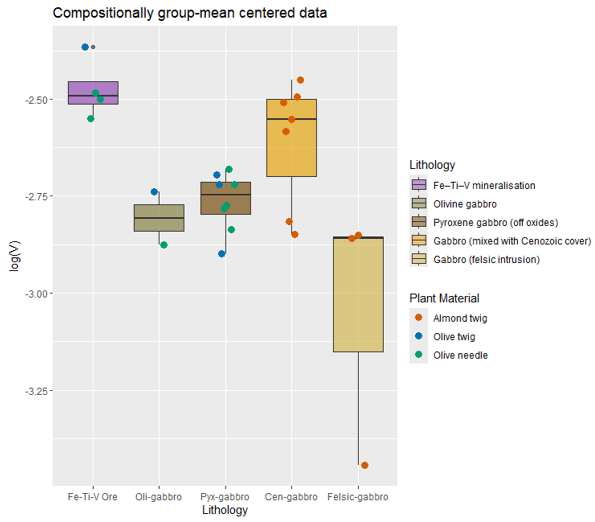
Because SEMACRET reference sites are so diverse from northern to central and southern Europe, we were able to test this premise and results are now in their way. Spoiler alert: We found out that plants can detect elements as diverse as nickel or vanadium which are then present in infinitesimal low concentrations in the plant tissues and can be used in non-invasive mineral exploration!
 SEMACRET